
Digital Marketing & Design Insights
Simple insights from marketing strategy and design practice.
Let’s be honest, digital marketing and design is basically just organized chaos with a color palette. One minute you’re crafting the perfect brand identity, and the next you’re explaining to a client why their logo can’t be “bigger, but also smaller, and maybe add some pizzazz.” (What even is pizzazz? Nobody knows, but everyone wants it.)
Welcome to the wild world where pixels meet persuasion, where A/B testing meets existential dread, and where every font choice feels like a philosophical statement. Buckle up, buttercup we’re diving deep.
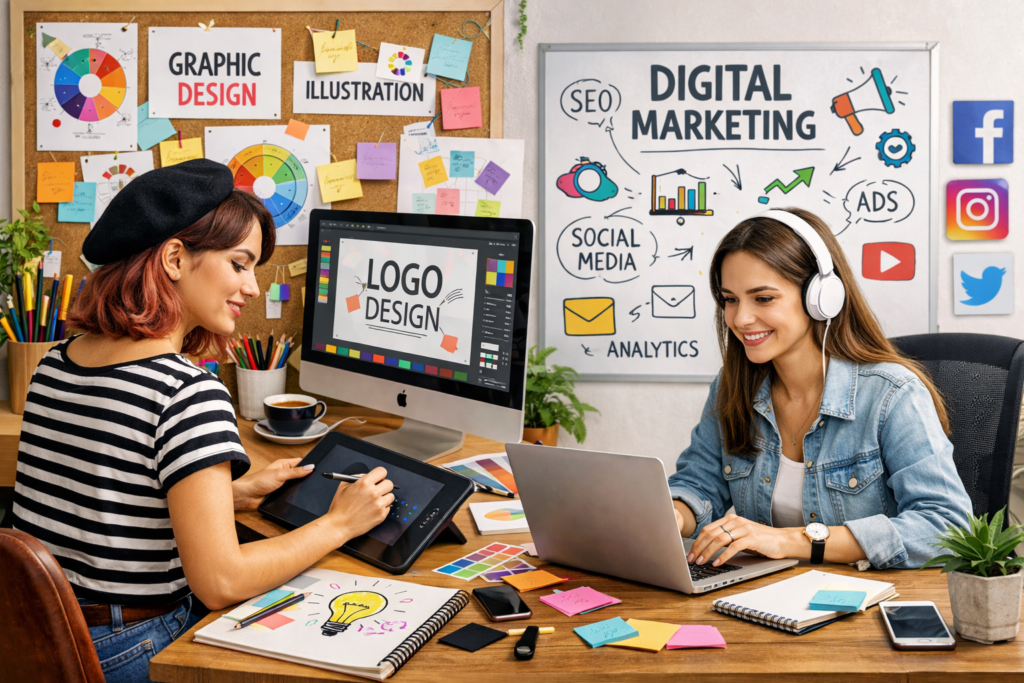
SEO: the art of making Google fall in love with you while still sounding like an actual human being. It’s like being a translator between robot overlords and real people. “Just write naturally!” they said. “But also include the keyword ‘best organic artisanal coffee beans Brooklyn’ seven times in the first paragraph!” they added. Here’s the truth bomb: Good SEO means understanding that search engines have gotten scary smart. They can tell when you’re keyword-stuffing like you’re making the world’s worst Thanksgiving turkey. The secret sauce? Create genuinely helpful content that answers real questions. Revolutionary, I know.
Social media marketing is beautiful because it combines the pressure of performing improv comedy with the soul-crushing reality of constantly changing platform algorithms. What worked on Instagram last month? Irrelevant. TikTok’s latest trend? Already over by the time you learned about it. And let’s talk about engagement rates for a second. Remember when getting 100 likes felt like winning the lottery? Now brands are treating a 2% engagement rate like it’s the holy grail. The reality check nobody wants to hear: Consistency beats virality every single time. You know what’s better than one post that gets 10,000 likes? Fifty posts that get 200 likes each and actually build a community that cares about what you’re doing.
Every year, someone declares email marketing dead. And every year, email marketing laughs maniacally while delivering a 4,200% ROI and sipping a mai tai on a beach somewhere. Why? Because people check their email. Revolutionary concept, I know. While organic social media reach is plummeting faster than my motivation on a Monday morning, email is still sitting in everyone’s pocket, waiting to be opened. But here’s where design and marketing actually have to be friends: Your email needs to look good and work. Mobile-responsive design isn’t optional, it’s mandatory. Nobody’s zooming in and squinting to read your 8-point font about your flash sale. If your email doesn’t work on mobile, it doesn’t work at all.
Let’s talk about how we’ve collectively decided that colors have feelings. Blue equals trust, which is why every bank and tech company uses it. Red equals excitement or hunger, hence every fast-food chain. Green equals nature and health, or money, depending on context. But here’s where it gets fun: Color psychology is realish, but it’s also culturally dependent and context-specific. That carefully chosen shade of purple that screams “luxury” to one audience might whisper “discount party supplies” to another. The best approach? Test it. A/B test your call-to-action buttons. Try different color schemes. See what actually works for your audience instead of blindly following what some design blog tells you.
Every marketer has two modes: “I’ve batch created content for the next three months and I’m basically a productivity god” and “it’s Tuesday and I forgot to post literally anything yesterday.” There’s no in-between. Content calendars are beautiful in theory. In practice, they’re that New Year’s gym membership full of promise in January, completely abandoned by March. Real talk: Perfection is the enemy of posting. That slightly imperfect post you publish today is infinitely better than the perfect post you’ll never finish because you’re too busy overthinking it. Ship it. Learn from it. Improve next time.
Here’s something nobody tells you about digital marketing: You’ll spend at least 40% of your time staring at graphs, wondering if that spike in traffic was genuine interest or just your mom clicking all your links. Understanding analytics is crucial, but it’s also easy to get lost in vanity metrics. Sure, 50,000 impressions sounds amazing, but if zero people clicked through, you basically just threw confetti into the void. What actually matters? Conversion rates, engagement quality, customer acquisition cost, and ROI the only three letters your boss actually cares about.
We can’t talk about digital marketing in 2025 without addressing the AI situation. Yes, AI can write your product descriptions now. Yes, it can generate images. No, it can’t replace the fundamental human skill of understanding what actually makes people care. AI is a tool a really impressive, sometimes scary tool but it’s still just a tool. The marketers and designers who’ll thrive are the ones who use AI to handle the tedious stuff so they can focus on strategy, creativity, and building genuine connections. Plus, AI-generated content has a certain vibe. You know it when you see it. It’s like algorithmic uncanny valley.
Digital marketing and design is constantly evolving, occasionally infuriating, and absolutely essential. It’s where art meets science, where creativity meets data, and where your carefully planned campaign meets the absolute chaos of real human behavior. The brands that win aren’t necessarily the ones with the biggest budgets they’re the ones that understand their audience, stay adaptable, and aren’t afraid to experiment and occasionally fail spectacularly. So whether you’re a seasoned pro or just starting out, remember: Every expert was once a beginner who didn’t give up after their first Facebook ad bombed. Keep learning, keep testing, and keep your sense of humor intact. Because if you can’t laugh at the absurdity of optimizing meta descriptions at 2 AM, you’re in the wrong industry.
Hi, this is a comment.
To get started with moderating, editing, and deleting comments, please visit the Comments screen in the dashboard.
Commenter avatars come from Gravatar.